- Healthcare
- By Copify

SEO for doctors helps your practice reach patients when they search for care, compare providers, and decide to book.
That first impression matters in healthcare. Your medical practice website, your Google Business Profile, and your published pages often impact how patients judge your credibility before they call.
An optimal SEO strategy builds growth systems for healthcare teams that want stronger visibility, cleaner reporting, and more booked visits.
What is SEO for Medical Practices?
SEO for medical practices improves a website so that a clinic appears in relevant search results and makes it easier for patients to take the next step.
SEO combines technical structure, local relevance, topic depth, and conversion paths. The goal is to show the right services to the right people in the right area.
Simple SEO
Simple medical SEO covers the core work every clinic needs. That means a fast website, accurate business profile information, clear service pages, and content built around the words patients already use.
It also means a clean structure. Good titles, readable layouts, strong internal links, and mobile usability help search engines understand your website. They help patients move through it with less hesitation.
Specialized SEO
Specialized SEO goes deeper for competitive specialties and high-value procedures. SEO for surgeons requires tighter page mapping, stronger authority signals, and sharper local strategy.
That is also where medical SEO becomes more exact. A medical website has to support visibility, protect trust, and guide patients toward action with precise information.
Why Is Medical SEO Important for Healthcare Practices?
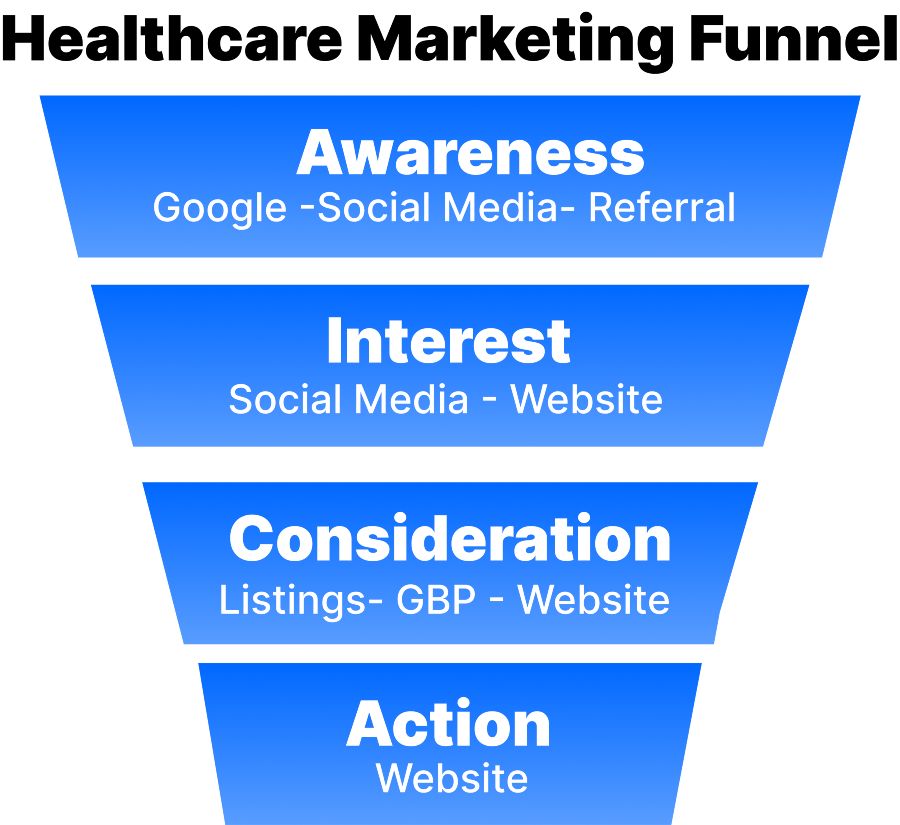
Most patients begin with a search. They compare websites, scan reviews, read credentials, and decide whether a clinic looks credible before they ever make contact.
A strong program gives your team more control over that process. It also creates a durable source of visibility that continues after ad spend stops.
Better visibility online
Better visibility means your clinic appears when patients search by symptom, service, specialty, or location. That reach brings in qualified traffic and helps your website attract people who are already close to a decision.
Local intent matters even more for medical practices. Patients who search with a city, district, or “near me” phrase usually want care soon, so local relevance directly affects growth.
Establishing trust and authority
Trust starts before the visit. Patients judge a provider through its website quality, provider information, review signals, and the depth of its information
Google also treats health topics with higher scrutiny. Its guidance explains that strong E-E-A-T matters more for YMYL areas such as medical information, so authority influences both ranking and conversion
A budget-friendly alternative to ads
With Copify, medical SEO builds value that lasts. Ads can create quick demand, while your online presence, local presence, and service pages can keep producing search visibility over time.
That makes the channel efficient for long-term growth. Many healthcare teams use it to improve stability, support brand reputation, and reduce pressure on paid acquisition.
Tracking clear, real-world results
Performance becomes useful when a clinic tracks the right actions. Your website should connect search traffic to calls, forms, bookings, and location actions that matter to operations.
Clear reporting improves decisions. We track rankings, landing-page results, and booked-patient signals. It helps your practice see which services drive the strongest business outcomes.
Essential Elements of a Successful Healthcare SEO Strategy
A successful healthcare SEO strategy combines local relevance, technical health, authority building, and high-value pages. It also needs consistent measurement so each practice can tie visibility gains to real business results.
Core priorities for each practice usually include:
- service and location mapping;
- website fixes that improve crawlability and mobile experience;
- editorial planning for high-intent topics;
- Business Profile management, reviews, and local citations;
- reporting tied to calls, forms, and bookings.
Typical Challenges in Medical Practice SEO
Physician SEO is competitive. Many providers target the same high-value terms. A practice also has to meet stricter trust standards, protect privacy, and adapt to result layouts shaped by AI and local features.
Common pressure points include:
- crowded service terms in major medical markets;
- limited visibility when maps dominate the page;
- thin or duplicated page copy across locations;
- weak authority signals for newer medical brands;
- tracking limits caused by privacy rules.
High-competition keywords
High-competition keywords demand time, patience, and sharp positioning. Broad medical phrases often favor large brands, directories, or hospital systems.
A smaller clinic can still win. The better route is narrower service pages, strong provider profiles, local modifiers, and content built around tighter intent.
Limitations in local search
Local search offers limited screen space. Google may show maps, reviews, AI features, and directories before users ever see a standard web listing.
That pushes a clinic to strengthen local data. Reviews, profile activity, service relevance, and page quality all influence visibility in the local pack and below it.
AI-driven ranking factors
AI-driven ranking factors are shaping how results are summarized and displayed. Google has expanded AI Overviews widely. Its publisher guidance says success still depends on crawlable pages, original information, and useful page content.
For a practice, the implication is direct. Medical information should be specific, structured, and expert-led so the site stays competitive as search behavior changes.
Authority requirements and YMYL standards
Authority requirements are higher in healthcare search because weak information can affect health decisions. Google states that its systems give more weight to strong E-E-A-T signals for YMYL topics. They include medical advice and provider information.
A practice should reflect that standard across the entire site. Provider address, credentials, editorial review, accurate service details, and consistent depth all strengthen trust.
Compliance regulations for healthcare content and advertising
Compliance regulations affect content, reviews, tracking, and marketing workflows. HHS has issued guidance on online tracking technologies in HIPAA-regulated settings. That changes how a medical practice should configure forms, analytics, and third-party tools.
This is where process matters. Our team helps healthcare groups publish content, gather reviews, and measure performance with a compliance-aware framework built for healthcare operations.
Why Choose Copify For Healthcare SEO?
A medical SEO partner should improve visibility and reduce friction inside the patient journey. That means stronger rankings, better conversion flow, and reporting that your practice can use.
We deliver strategy, content, technical work, local optimization, and measurement in one operating model. You get one team, one roadmap, and one clear direction.
Results-driven medical SEO
Results-driven SEO for physicians focuses on booked outcomes. We improve page targeting, strengthen service relevance, and connect visibility growth to the services that matter most to a practice.
That keeps the work practical. Your website does more than collect traffic; it supports a measurable pipeline of new patients.
Real-time performance dashboard
A real-time dashboard gives a practice visibility into rankings, traffic, leads, and conversions. It replaces guesswork with a live view of search performance.
That visibility supports speed. Your healthcare team can spot movement early, reset priorities, and keep the platform aligned with the strongest opportunities.
Content that ranks and converts
Content that ranks and converts has to do two jobs at once. It must satisfy Google and help patients trust the practice enough to take the next step.
We build editorial calendars around service demand, patient questions, provider authority, local intent, and supporting content needs. That keeps each asset useful, focused, and persuasive.
SEO-integrated online booking
Online booking works better when SEO and UX are connected. Patients should be able to move from search to page to booking action without friction.
We improve structure, CTA placement, and mobile flow so the website supports faster decisions. That closer link between page copy and conversion helps a practice capture more high-intent demand.
Review generation supports local trust when it is handled with the right safeguards. Healthcare organizations also need to respect privacy requirements when they request or display patient feedback.
Copify uses automated review workflows that fit a compliance-aware process. Contact us if you want a growth plan that supports Google visibility and fits the privacy requirements of your medical practice.
Social media and blog synergy help a practice extend the life of each content asset. A strong article can support search, answer common questions, and give your team material for email and social distribution.
That cross-channel use improves reach. It also sends qualified visitors back to the website, where strong service pages and clear next steps can convert them.
When Will You See Results From SEO Strategy for Doctors?
Healthcare SEO timing depends on your market, website condition, competition, and starting authority. Many practices see early movement within the first few months, but broader gains usually take longer to compound.
A practical timeline with Copify looks like this:
- Months 1–2. Content audit, keyword mapping, technical fixes, and local cleanup
- Months 2–4. Page launches, review growth, internal linking, and refinement
- Months 4–6. Stronger movement for focused terms and service pages
- Months 6+. Broader authority, steadier traffic, and better conversion efficiency
Start with the highest-value services and the clearest local search intent. That way gives earlier wins to the practice, while the rest of the site gains depth and authority.


FAQs About SEO for Physicians
How much does medical SEO cost?
Medical SEO cost depends on the size of the practice, the condition of the site, and the level of content production required. A smaller medical office usually needs a narrower scope.
The budget should match the business goals for the medical practice. Growth comes from steady technical work, content updates, local optimization, and reporting. The right package depends on how fast your practice wants to grow.
What are the four types of SEO?
The four main types are:
- on-page SEO
- technical SEO
- off-page SEO
- local SEO
A medical practice usually needs all four. Site performance depends on website quality, authority, local relevance, and content depth.
Copify delivers all four healthcare SEO types. We provide a unified strategy, giving your practice stronger rankings, better local visibility, and higher trust. It serves as a clear route from search traffic to booked appointments.
Where do patients search for medical experts?
Patients search in several places. Google remains central, but they also use maps, reviews, health directories, social platforms, and the site of the practice they are considering.
That is why the strategy has to be broad. A practice needs visibility in maps and Google, a strong website, accurate listings, and useful information that answers key questions before contact.
Why is local SEO vital for medical practices?
Local SEO is vital because patients usually want nearby care, clear directions, and fast contact options. A practice that wins local search can capture higher-intent demand than a site that ranks only for broad informational terms.
It also boosts relevance. When pages, profile data, and reviews all support the same area, Google gets a stronger signal about where those medical services belong.
What SEO content should doctors publish?
Doctors should publish content that answers real patient needs. Service pages, provider bios, treatment explainers, FAQs, insurance guidance, location pages, and post-visit instructions can all support visibility and trust.
The best content connects medical accuracy with readability, and that content has to stay current. That makes the website more useful for patients and gives Google more reasons to rank the practice for relevant questions.
What is "doctor Google" and why does it matter?
“Doctor Google” describes the habit of patients using search engines before they speak with a provider. They use Google to check symptoms, compare medical options, and decide whether a practice looks credible enough to contact.
That patient behavior affects demand generation from the first click. If your website, your information, and your Google presence do not answer those early questions, patients will keep comparing options.
Related Posts