- By Copify
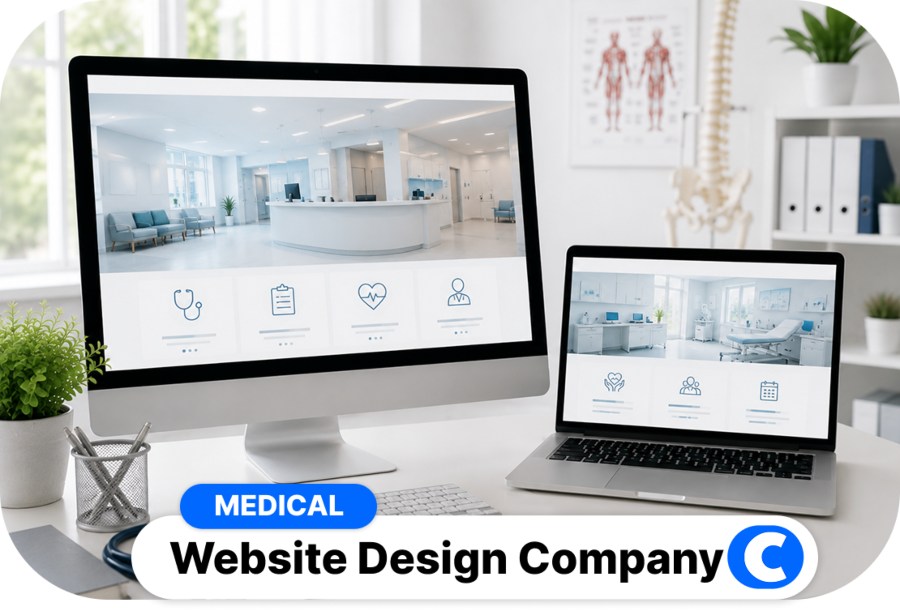
Patients decide whether to trust a clinic within seconds of opening its website. Our medical website design company can help you win that trust from the first click. We build sites that load fast and make booking simple.
Schedule a consultation – let’s discuss how we at Copify can help your practice grow online.





What Should Medical Website Development Include?
A healthcare medical website is the first impression your practice makes on your future patients. Every aspect should foster trust. Here is what Copify usually includes in compliant healthcare projects:
- Appointment scheduling that integrates with your calendar.
- Clear service pages that explain treatments in plain language, not medical jargon.
- Doctor and staff profiles with photos and areas of expertise.
- Mobile-first design – more than 60% of patients look up doctors on their mobile devices.
- Fast loading time even on slow connections (less than 3 seconds).
- Information about insurance and payment so that patients understand what to expect before calling.
- Patient reviews and testimonials positioned to aid in booking and conversion.
Web Design for Doctors Healthcare Website Features
While each medical practice is unique, certain healthcare website solutions have become commonplace for any site. It will depend on your specialty and business goals. Below are the features we recommend for most healthcare websites.
Patients need to know the price before they call. Having a clear pricing page, even if it has a range or a starting price, can help minimize calls and increase trust. The prices displayed in tables are easily scannable and updatable.
Any data-collection form must follow HIPAA guidelines. All intake forms, contact forms, and appointment requests are configured with encryption and appropriate consent fields. This can help reduce compliance risks and protect patient trust.
Symptom checkers, treatment guides, and recovery timelines give visitors a reason to stay on your healthcare site. These tools also position your healthcare practice as a reliable source of information, which will benefit your SEO and patient retention in the long run.
Patients expect to pay medical bills just as they do for everything else. Your healthcare website should be linked to secure payment processors. This allows patients to pay bills in a couple of clicks, without having to log in to a separate healthcare portal or call the front desk.
If your practice has more than one doctor, a searchable directory lets patients find the right providers by name or location. The path from search to appointment should be short and simple.
What Does a Healthcare Web Design Company Do?
Medical website development covers everything from the first sketch to the monthly reports. Below is a breakdown of what falls under each stage.

Core services overview
The core services cover everything needed to turn an outdated or missing website into a healthcare site that supports patient acquisition.
Services beyond launch
Medical practice website design is not a one-time project. Search engines update their rules, and security threats keep evolving. Without proper care after launch, even the best healthcare site will lose potential patients to competitors within a year.
Medical Website Design and SEO for Better Visibility
A beautiful website means nothing if patients can’t find it on Google. Medical SEO differs from standard SEO due to the specific guidelines search engines have for health-related content. That is why SEO decisions should be part of a doctor website design from day one.
SEO-friendly website structure
• Logical URL paths like /services/cardiology.
• Internal links between related services, doctors, and conditions.
• A sitemap that search engines can crawl without errors.
• Page hierarchy that keeps important pages 1-3 clicks away from the homepage.
Medical content optimization
Local SEO for doctors and clinics
• An optimized Google Business Profile.
• Consistent address and phone number in directories.
• Location pages for each clinic, if you have more than one.
• Patient reviews collected and responded to on a regular basis.
• Local keywords used in titles, headings, and text without sounding forced.
When Does a Medical Website Need a Redesign?
A redesign is needed if your site loads slowly or looks dated on mobile. Other warning signs include broken booking forms, low Google rankings, and HIPAA gaps in how patient data is collected.
If your site still uses Flash, has no SSL certificate, or has not been updated in years, a full rebuild is usually cheaper than patching old code.

Our Site Compliance and Accessibility Requirements
Medical websites carry legal risks that other industries don’t face. Even small issues in forms, consent fields, or data handling can create compliance risks. This is why compliance should not be an afterthought that is tacked on after the site is live.

HIPAA healthcare privacy standards
• Encrypted data transmission.
• Signed Business
• Associate Agreements with every vendor that touches patient data.
• Access controls and audit logs for staff accounts.
• Automatic session timeouts on patient portals.
ADA and WCAG accessibility compliance
GDPR and CCPA data protection
• An easily understood privacy policy.
• Opt-in and opt-out cookie consent banners.
• Clear procedures for data requests with legal time limits.
• Consent logs for email marketing and tracking.
Secure SSL/TLS encryption
See What Clients Say About Doctor Website Design
The best way to judge a partner for web design for doctors is to hear from the people who hired them. Check the reviews below to see what clinic owners say about our work.


FAQs About Medical Practice Website Design
What is the cost for a small practice site?
A small practice site will cost between $3,000 and $5,000. The final price depends on the number of pages, custom features like booking systems, and whether you need copywriting or photography included.
How long does it take to build a medical website?
The typical medical website development time is 6-10 weeks from start to finish. Custom integrations and multiple physician profiles may take up to four months to complete.
How involved do I need to be in the design process?
Plan for 4 to 6 hours of your time for the project. You will review wireframes, approve designs, provide details, and sign off before launch. Everything else is handled on our end.
How does a redesign impact SEO rankings?
A redesign can either boost or hinder rankings, depending on how it’s done. Most sites retain their rankings and can even experience an increase in traffic within a few months with the right URL mapping and content migration.
Who owns the code and content after launch?
Once the final invoice is paid, you own everything. You also have full admin access, which means you can change your developer or host at any time.
Share This Page!
Related Posts